Alex Maskara
Thoughts, Stories, Imagination of Filipino American Alex Maskara
Welcome
HOME
The Last of the Baluga
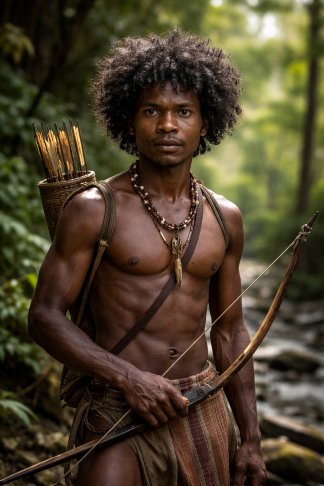
The Last of the Baluga
O Caca, O Caca
Cabalat capaya
Sabian mu nang tutu
Nung ena ca bisa
Ceta pu cecami
Dacal lang baluga
Mangayap la ceca
Biasa lang mamana.
(O Brother, O Brother,
whose skin is the color of papaya,
tell me at once
if you no longer wish to fight.
Because where I come from,
I can gather many Baluga—
far better than you
with bows and arrows.)
------
I am Pandaca, named after the second smallest fish in the world. I wear the name with equal shame and pride. It tells the truth about me before my body does: I am small, mountain-born, and easily overlooked.
I was born in Mariveles and wandered south as a boy until I settled on the slopes of Pinatubo. You know what happened there. When the mountain erupted, I moved again—to Arayat—because I am Baluga, and the mountains have always been my home.
You prefer to imagine me as a silhouette: naked except for a g-string, bow lifted, arrow drawn, frozen forever against the sky. Or playing a nose flute in a tree beneath a full moon. I exist for you as an image, not as a man. An anito—useful for stories, harmless because I am distant.
You are not wrong. I was once exactly that. And your blood remembers me even if your mind denies it.
I was here before you. I crossed land bridges when the sea still slept. I planted the first seeds in this volcanic soil. I did not fight when others arrived—first from Sumatra, then from the Malay Peninsula. I stepped aside and climbed higher. The mountains were sacred to us. They belonged to Sinukuan, our goddess. Civilization never tempted me. The forest was enough.
I bartered meat for salt, rice for cloth. That was our agreement with the lowlands. But when the forest was stripped bare and the animals vanished, I lost everything—food, shelter, dignity, even my right to remain. You did not stop until we were nearly gone.
Now I sit in one of the last trees on this mountain. Below me, the land is shaved flat, wide enough to see the city miles away. You call this progress. You erase centuries in minutes and sleep soundly at night.
From your balconies—in Switzerland, America, Baguio, Tagaytay—you drink and look out at mountains you no longer touch. Meanwhile, families like mine descend from the slopes, knocking on doors, begging for food, discovering that even those with houses are starving.
If you still imagine me on a cliff, let me remain there forever in your dreams. You will never see forests again. These mountains will become subdivisions. And when my generation ends, I will vanish with it.
Yes, I am alive. But survival is not life. I remember when our children laughed, when leaves whispered overhead, when the land welcomed us wherever we went. Trees were roofs. Birds laid eggs freely. Sinukuan watched.
Now our flutes are silent. Our bows are useless. I hold this tree as if it were a dying relative. We are both waiting.
Her spirit is young. She is searching for her mother, cut down days ago. Her grandparents—trees older than memory—fell without a sound, too shocked to cry. I try to soothe her, but the chainsaws are already singing.
I will not leave her. Without her, I do not exist.
I close my eyes and hum the old songs—memories carried in blood since the beginning of time. I see our people walking the mountains without fear. I see abundance so natural it felt eternal. This land, once blessed, is dying.
There is so much I want to say before I die with this tree.
It does not take brilliance to heal what you destroyed. This mountain needs trees—and to be left alone. Nothing more.
But you have chosen another way.
The men arrive with bulldozers. They shout the same words as before: “Get down from the trees, you monkeys.” This time, I am not afraid.
I will let my body scatter across this emptied land.
This is the last thing I can give.
And I know—no one will care.
-------
Historical and Cultural Notes
Baluga / Aeta
“Baluga” is a Kapampangan term often used to refer to the Aeta—one of the oldest indigenous groups in the Philippines. They are Negrito peoples, characterized by dark skin, curly hair, and short stature. Historically semi-nomadic hunter-gatherers, they lived sustainably in forests long before Austronesian settlers arrived.
Land Bridges and Early Settlement
The story references prehistoric land bridges that once connected the Philippine archipelago to mainland Asia during the Ice Ages. Archaeological and genetic evidence supports the presence of Negrito populations in the Philippines tens of thousands of years ago, predating later waves of Austronesian migration.
Mount Pinatubo
The 1991 eruption of Mount Pinatubo was one of the largest volcanic eruptions of the 20th century. It devastated Aeta communities, many of whom were permanently displaced. Resettlement programs often failed to account for indigenous lifeways, leading to poverty, cultural erosion, and dependence.
Mount Arayat
Mount Arayat, in Pampanga, is a solitary volcanic mountain long associated with Kapampangan mythology. It is traditionally considered a sacred place and a refuge—both physically and spiritually—for indigenous peoples pushed out of lowland areas.
Sinukuan
Sinukuan (also spelled Sínukuan or Aring Sinukuan) is a pre-colonial Kapampangan deity associated with Mount Arayat. Often portrayed as a guardian spirit or mountain god, Sinukuan represents balance, fertility, and the sacredness of the land—values central to indigenous cosmology.
Anito
“Anito” refers to ancestral spirits or nature deities in pre-colonial Philippine belief systems. In the story, the narrator becomes an “anito” in the modern imagination—reduced to myth, stripped of living presence.
Deforestation and Displacement
Large-scale logging, mining, and land conversion—especially during the 20th century—led to massive forest loss in Central and Northern Luzon. Indigenous peoples were among the first displaced, often criminalized for practicing subsistence lifestyles in lands reclassified as “private” or “development zones.”
The Monkey Slur
The insult shouted by bulldozer drivers echoes real historical dehumanization of indigenous peoples in the Philippines. Such language justified land seizure and violence by framing natives as less than human.
2026-02-01 22:11:41
shortstories
Visions of St Lazarus Chapter 7
Reflection on Being Alone with a Purpose
Contemplation of an Ordinary Man
American Son by Brian Ascalon Roley
Linda Ty-Casper: Awaiting Trespass
Personal Thoughts while Sampling the poetry of Nick Carbo
Naomi: Reflection on Holy Week
Visions of St Lazarus : Expanded version of Lazarus Kafkaesque Paper
Ramon Santos Reflections While Recovering
The Mild Stroke of Ramon Santos
Popong 22: Meditation On Handling Temptations
Popong 21 - Friday Night Reflection
Popong 19/ Life is Learning and Exploring
Popong 18 / Avoiding Distraction
Popong 12 / Meditation on Computer Obsession
Sunday Thoughts and Book Review
A Night at the Luneta Grandstand
Understanding my unique Self on my way to Retirement
A Visit to Quiapo with El Fili2
THE DIARY OF ANTONIO PIGAFETTA
Brother, My Brother (Ben Santos)